
About to text a price? Know your real number first.
Every app for a one-man shop helps you send the price faster. None of them tells you what it should be. True Rate works it out from your own costs, then prices the job off it.
- Business costs $2,870 a month
- Plus $60,000 a year in pay
- 45 hours a week, 48 weeks
- 62% of hours billable: 1,339 hours
- Break-even: $70.52 an hour
- Charging $65: below break-even
- 12.6 weeks a year for free
“I’m about to text a price. Is it right?”
That’s the moment True Rate is for. You’re in a driveway with the phone in your hand, and the customer’s waiting on a number.
-
Get your real rate in six numbers.
What you charge now, hours a week, weeks a year, the pay you want, what the business costs a month, and the hours a customer actually pays for. Free, no email.
Get your real rate -
Price the job, copy the text.
Price a job off that rate and copy a ready-to-send price text for the customer. The number in it is one you worked out, not one you hoped for.
Price a job -
After the job: was that job worth it?
Four numbers from the job you just finished: what you charged, real hours door to door, real materials and subs, and the extras. It tells you what the job really paid you an hour.
Check a finished job
“I’m pulling the numbers out of my behind.”
What a contractor said online, on r/handyman
The going rate is somebody else’s guess.
“What the other guy charges” is the number everybody uses and nobody figured. The other guy doesn’t know his costs either, and he doesn’t pay your truck payment.
One solo shop, worked through: $2,870 a month to run the business, $60,000 a year in pay, 45 hours a week for 48 weeks, 62% of those hours billable. It charges $65 an hour.
- Break-even
- $70.52 an hour: the bills and your pay, zero profit
- Target, 20% margin
- $88.15 an hour: what the kit prices from
- Shop rate
- $90 an hour, rounded up
You work 12.6 weeks a year for free.
- Paid through week 35
- 3.0 weeks below break-even
- 9.6 weeks of profit not charged
At $65 against the $88.15 target, that’s $31,002 a year left on the table. Counted in weeks instead of dollars, the year’s pay is in by week 35. Everything after that is on the house.
A 30% markup keeps 23%.
$1,000 of materials marked up 20% bills at $1,200. Profit is $200, which is a 16.7% margin, not 20%. To actually keep 20% you need a 25% markup: $1,000 × 1.25 = $1,250, profit $250.
“Just found out I made 8% on a job I thought was 25%.”
What a contractor said online, on r/Contractor
| Markup | Margin |
|---|---|
| 20% | 16.7% |
| 25% | 20% |
| 30% | 23% |
| 50% | 33% |
Six tabs and the texts nobody likes writing.
A Google Sheets / Excel kit that works on your phone. Fill in your numbers once. Everything else prices off them.
My Numbers
Business costs, pay goal and realistic billable hours: your break-even and target rate.
Price Book
80 common handyman and remodel jobs, flat-priced from your rate. Starter hours you edit.
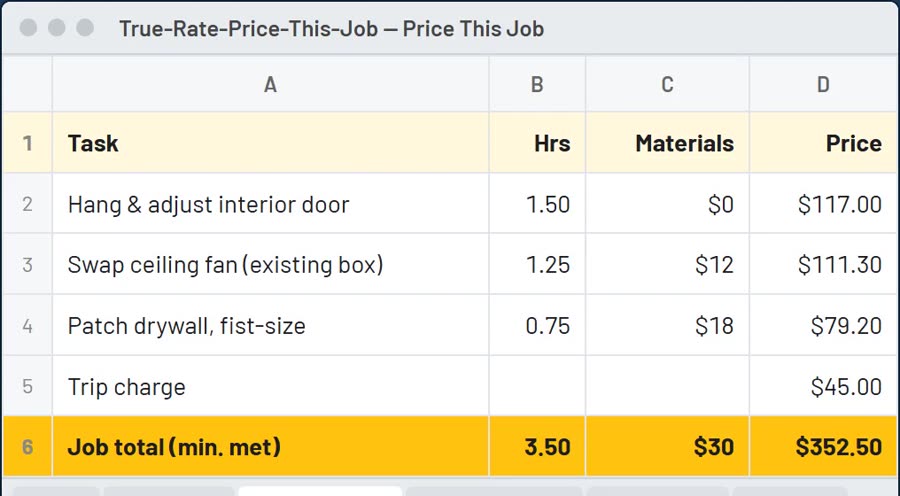
Price This Job
Pick tasks, add materials, subs, trip charge and minimum. See the price and the margin, with a warning if it’s too low.
Markup and Margin
The converter, plus a materials and subs markup table.
Was I Right?
Estimate against actual after every job, so you see which jobs really made money.
Client estimate
A client-ready estimate sheet.
Get Paid Texts
The “while you’re here” change-order text, deposit and payment-schedule wording, final-payment reminders.
- One-time price. No subscription.
- Your data stays in your own Google Sheet.
- Built from your own costs, not national averages.
- Works on your phone in Google Sheets. No app to learn.
What it won’t do.
It’s a spreadsheet. It’s only as honest as the numbers you put in it.
- 60 to 65% billable is a rule of thumb. It isn’t a statistic. Put in your own if you know it.
- The Price Book hours are starters. Edit them to how fast you actually work, or the flat prices are someone else’s.
- It’s not field-service software. It prices the job and checks it afterward. It doesn’t schedule, dispatch or take payments.
- The texts are wording, not legal advice. Contract and lien rules vary by state.
- The answers are estimates from the numbers you enter, not financial or tax advice.
- Checkout isn’t open yet. The free tools are. The kit button goes to the True Rate site.
Pay once. Then it’s yours.
The full kit: six tabs plus Get Paid Texts, in Google Sheets or Excel. Know your real number before you text the price.
Questions? Write to contact@fantasylab.tech